
Denim Weaving Energy Saving in Pakistan: How Sanyou Saved 142 kW at Soorty Denim Mill Karachi
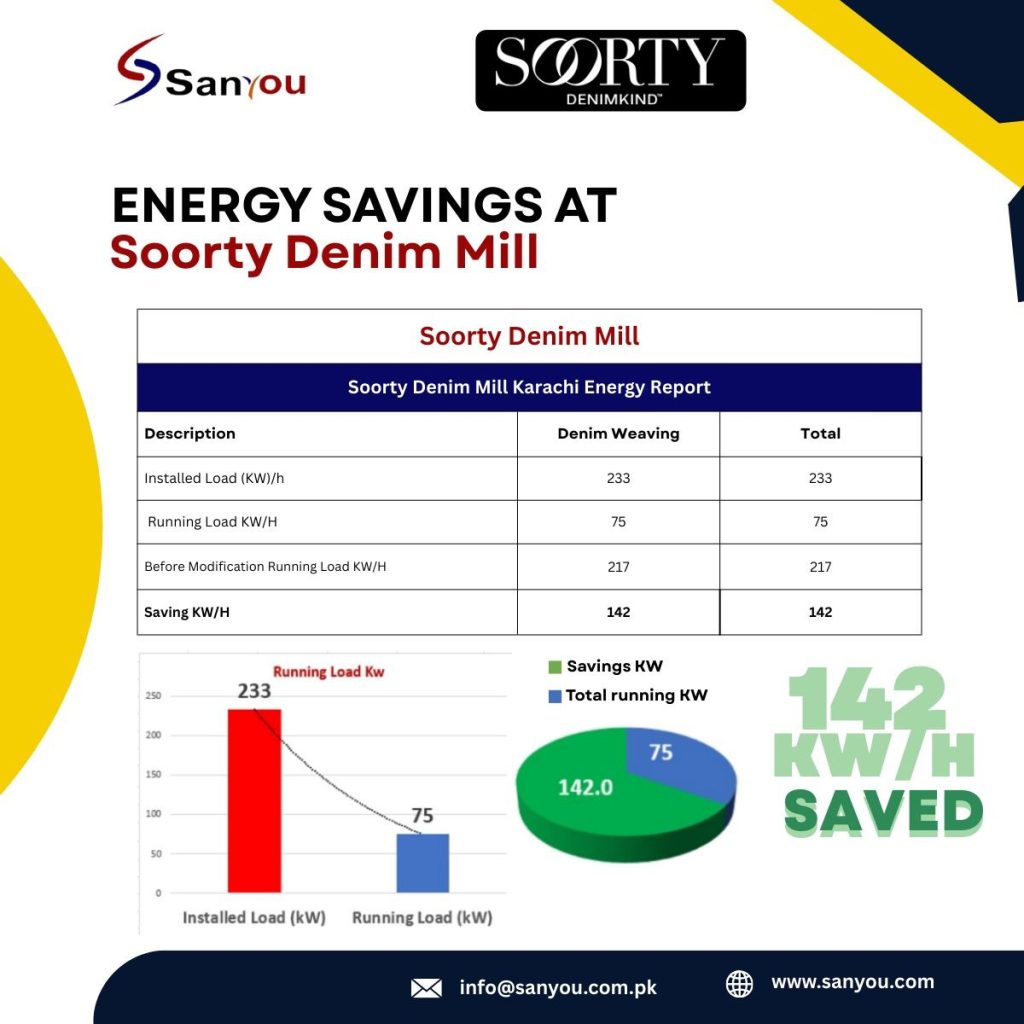
Case Study Denim Weaving Section · Karachi 142 kW Saved How Sanyou Machinery & Technology reduced the Denim Weaving section at Soorty Denim Mill Karachi from 217 kW to 75 kW — a 142 kW saving with zero disruption to production. 📅 July 2026 ✍ Sultan Mahmood ⏰ 7 min read Denim weaving energy saving Pakistan reached a new benchmark at Soorty Denim Mill Karachi, where a Sanyou energy audit of the Denim Weaving section uncovered and permanently eliminated 142 kW of avoidable electrical load — cutting the section’s running consumption by 65.4% without stopping a single loom. 233 kW Installed Load 217 kW Load Before 75 kW Running Load After 142 kW Total Saved Denim Weaving Energy Saving in Pakistan: The Challenge at Soorty Denim Mill Karachi Soorty Denim Mill is one of Pakistan’s leading denim fabric manufacturers, operating out of Karachi with a vertically integrated production facility. The Denim Weaving section — the department where yarn is interlaced into denim fabric on high-speed rapier and air-jet looms — had an installed electrical capacity of 233 kW. Before Sanyou’s intervention, the section was running at 217 kW — close to its full installed capacity. Loom main motors, warp beam drives, let-off and take-up motors, shed-forming mechanisms, weft insertion systems, and the associated HVAC and pneumatic infrastructure were all consuming power at levels that had never been individually measured or challenged. No VFDs had been installed on ancillary motor circuits. Power factor had never been corrected at section level. No sub-metering existed to separate the Denim Weaving section’s consumption from the rest of the facility. The mill was paying for 217 kW of electrical demand when the actual productive work required far less. Why Denim Weaving Is a High-Value Energy Audit Target Denim weaving sections run 24 hours a day, 340+ days a year, at high motor counts per loom. A facility with 100 looms has hundreds of individual motors — main drives, let-off units, take-up units, warp stop motion systems, and shed drives — all running simultaneously. The sheer density of motors, combined with the continuous operating cycle, means even a small per-motor saving multiplies into a very large section-level reduction. This is why denim weaving energy saving projects consistently deliver among the highest absolute kW savings in Pakistan’s textile sector. What the Energy Audit Found in the Denim Weaving Section Sanyou’s engineers clamp-metered every motor circuit across the Denim Weaving section during steady-state production. Four distinct sources of correctable electrical waste were identified and quantified. 1 Ancillary motors running at fixed full speed regardless of loom state Denim looms have numerous ancillary motors — warp beam let-off, fabric take-up, selvedge tuckers, weft feeders, pneumatic compressors, and humidity control fans — all running at fixed maximum speed during every operating state including maintenance stops, doff changes, and warp beam loading. These motors were not linked to loom production state. A loom stopped for 20 minutes for a warp break was still drawing full ancillary power throughout. VFDs tied to loom run-signals correct this immediately. 2 Section HVAC and humidification running at 100% capacity continuously The Denim Weaving section’s climate control system — critical for maintaining yarn moisture and preventing warp breakages — was running at fixed full capacity regardless of ambient conditions, season, or production load. Humidity and temperature control fans operated on manual settings that had not been adjusted since commissioning. VFD-based demand control on HVAC motors, responding to actual temperature and humidity sensors, typically reduces climate control energy consumption by 35–50% without compromising weave room conditions. 3 Power factor below acceptable threshold across the weaving section bus The weaving section’s power factor had degraded to below 0.75. With KESC (K-Electric) billing Karachi industrial consumers on kVA demand, every unit of reactive power was being charged at the same rate as productive active power. A power factor of 0.75 means the mill was paying for 33% more electrical supply than it was productively using. Capacitor bank installation at the Denim Weaving distribution panel corrected this to 0.95+ immediately and without any change to production operations. 4 No sub-metering — section consumption had never been individually tracked The Denim Weaving section shared a utility metering point with other departments. Its individual consumption had never been measured. Without a baseline, no corrective action had ever been possible and no benchmarking had ever been done against industry norms for denim weaving energy consumption per metre of fabric. Installing section sub-meters created the first accurate picture of actual consumption in the section’s operational history and enabled the before-and-after saving to be documented and verified. The Result: 142 kW Eliminated from the Denim Weaving Section Soorty Denim Mill Karachi — Denim Weaving Load Comparison Installed Load233 kW Running Load Before Modification217 kW Running Load After Optimisation75 kW Total kW Saved142 kW Load Reduction65.4% Est. kWh saved per day (20h)2,840 kWh Est. monthly saving (PKR 60/unit)~PKR 5.1M/month Running Load Breakdown After Optimisation Energy Saved (eliminated) 142 kW — 65.4% Remaining Running Load 75 kW — 34.6% Key Result The Denim Weaving section at Soorty Denim Mill Karachi now runs at 75 kW — less than one-third of its pre-optimisation load of 217 kW. 142 kW has been permanently removed from the facility’s electrical demand. Fabric production, loom speeds, and weave quality are unaffected. The saving is fully recurring — every month, every year. The Four Interventions That Delivered 142 kW of Denim Weaving Energy Saving Power Factor Correction Capacitor banks sized and installed at the Denim Weaving distribution panel. Corrected power factor from below 0.75 to 0.95+. With K-Electric billing on kVA demand in Karachi, this single intervention immediately reduced the apparent electrical demand charged to the mill each month. VFD Installation on Loom Ancillaries Variable Frequency Drives installed on let-off motors, take-up motors, and weft feeder drives. Speed matched to actual loom production state. Motors ramp down during stops and ramp up on restart — eliminating fixed-speed consumption during non-weaving states. HVAC Demand Control Humidity and temperature control fans fitted with VFDs
Ring Frame Energy Saving in Pakistan: How Sanyou Saved 263 kW at Suraj Cotton
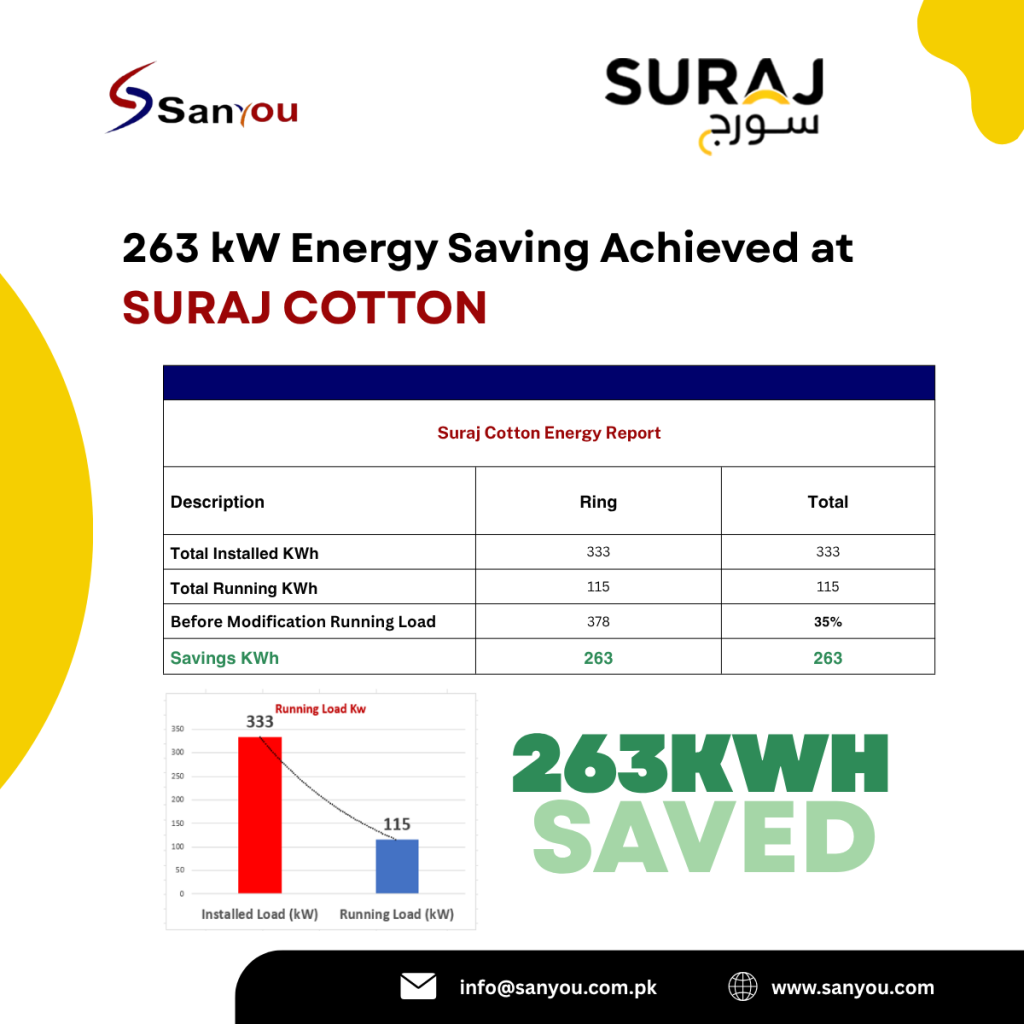
Case Study Ring Frame Section 263 kW Saved How Sanyou Machinery & Technology cut 263 kW from the Ring Frame section at Suraj Cotton — reducing running load from 378 kW to 115 kW with zero production downtime. 📅 June 2026 ✍ Sanyou Machinery & Technology ⏰ 7 min read Ring frame energy saving in Pakistan delivered a breakthrough result at Suraj Cotton, where Sanyou’s engineering audit of a single Ring section uncovered and eliminated 263 kW of avoidable electrical load — the equivalent of powering more than 260 average Pakistani homes, removed permanently from the mill’s monthly utility bill. 333 kW Installed Load 378 kW Load Before Modification 115 kW Running Load After 263 kW Total Saved Ring Frame Energy Saving in Pakistan: The Situation at Suraj Cotton Suraj Cotton operates a Ring Frame spinning section with an installed electrical capacity of 333 kW. Before Sanyou’s intervention, the actual running load measured at 378 kW — a figure that exceeded even the installed nameplate capacity. This is not uncommon in mills where reactive power losses, power factor degradation, and uncontrolled ancillary loads push the metered consumption above the theoretical installed rating. The mill had no section-level sub-metering. No variable frequency drives had been installed on fan or suction motors. Power factor had never been corrected at the Ring section panel. The electrical system was running exactly as it had been commissioned — with no optimisation applied at any point in the section’s operational life. Sanyou Machinery & Technology was brought in to conduct a targeted ring frame energy saving project. The scope was focused: one section, one audit, one engineered solution. The result was a 263 kW reduction — a 69.6% decrease in running load that continues to save the mill millions of rupees every month. Important: Running Load Exceeded Installed Load The before-modification running load of 378 kW exceeded the installed nameplate capacity of 333 kW. This happens when reactive power (kVAR) drawn by induction motors at poor power factor inflates the apparent load on the metering system. A mill being billed on kVA rather than kW will pay for every unit of this reactive excess. Power factor correction alone — before any VFD installation — can immediately bring metered consumption below the installed rating. What the Ring Frame Energy Audit Found at Suraj Cotton Sanyou’s engineers conducted an individual motor clamp meter survey across the entire Ring section during steady-state production. Four distinct sources of correctable waste were identified. 1 Severely degraded power factor The Ring section’s power factor had dropped below 0.72. At this level, every motor in the section was drawing substantial reactive current from the supply — current that does no productive work on fibre but appears on the WAPDA kVA meter and is billed accordingly. This reactive excess was pushing the apparent running load above the installed nameplate rating, creating the 378 kW reading. In any ring frame energy saving project, power factor correction is always the first and fastest payback intervention. 2 Fixed-speed suction and exhaust fan motors Every ring frame in the section had pneumatic waste collection fans running at fixed full speed, 24 hours a day, regardless of spindle speed, count being spun, or production state. These fans were sized for maximum throughput conditions but were consuming full power even during count changes, doffing, and partial-load production. A VFD reducing fan speed to 80% of maximum drops power consumption to approximately 51% due to the cube law — a saving that compounds across every fan motor in the section. 3 Oversized ring frame motors at chronic partial load Ring frame main drive motors are sized at commissioning for the worst-case scenario: finest count, maximum spindle speed, and full spindle complement. In daily production at Suraj Cotton, the section was running coarser counts at reduced speeds. Motors sized for peak demand were operating at 35–50% of their rated capacity — the most inefficient operating point for any induction motor, combining high copper losses with poor power factor. 4 No sub-metering — waste was invisible The Ring section had never been individually metered. The entire spinning floor shared one utility meter, meaning the Ring section’s consumption had never been separated from other departments. Without individual measurement, no corrective action had ever been possible. Installing section-level sub-meters was the foundational step that made every subsequent intervention traceable and verifiable. The Result: 263 kW Eliminated from the Ring Section Suraj Cotton — Ring Section Load Comparison Installed Load333 kW Running Load Before Modification378 kW Running Load After Optimisation115 kW Total kW Saved263 kW Load Reduction69.6% Est. kWh saved per day (20h)5,260 kWh Est. monthly saving (PKR 60/unit)~PKR 9.5M/month Running Load Breakdown After Optimisation Energy Saved (eliminated) 263 kW — 69.6% Remaining Running Load 115 kW — 30.4% Key Result A single section. A single audit. 263 kW permanently eliminated. The Ring section at Suraj Cotton now runs at 115 kW — less than one-third of its pre-optimisation load. No machines were replaced. No production shifts were cancelled. Yarn quality and throughput were maintained throughout. The Engineering Interventions That Delivered the 263 kW Saving Power Factor Correction Capacitor banks sized and installed at the Ring section distribution panel. Corrected power factor from below 0.72 to 0.95+. Immediately reduced apparent load on the WAPDA meter below the installed nameplate rating. VFD Installation on Fan Motors Variable Frequency Drives installed on all suction and exhaust fan motors across the Ring section. Fan speed matched to actual production state. At 80% speed, power consumption drops to 51% of full-speed draw. Section Sub-Metering Individual sub-meters installed at the Ring section panel, providing real-time consumption data for the first time in the mill’s operational history. Enables ongoing monitoring and immediate detection of future load increases. Motor Right-Sizing Motors found running below 35% of rated capacity were flagged for right-sizing. Replacing an oversized motor with a correctly-rated unit for the same task reduces both active and reactive losses, compounding the savings from VFD and capacitor interventions. What 263 kW Saved
Spinning Mill Energy Audit Pakistan: How Sanyou Saved 443 kW at Indus Dyeing and Manufacturing
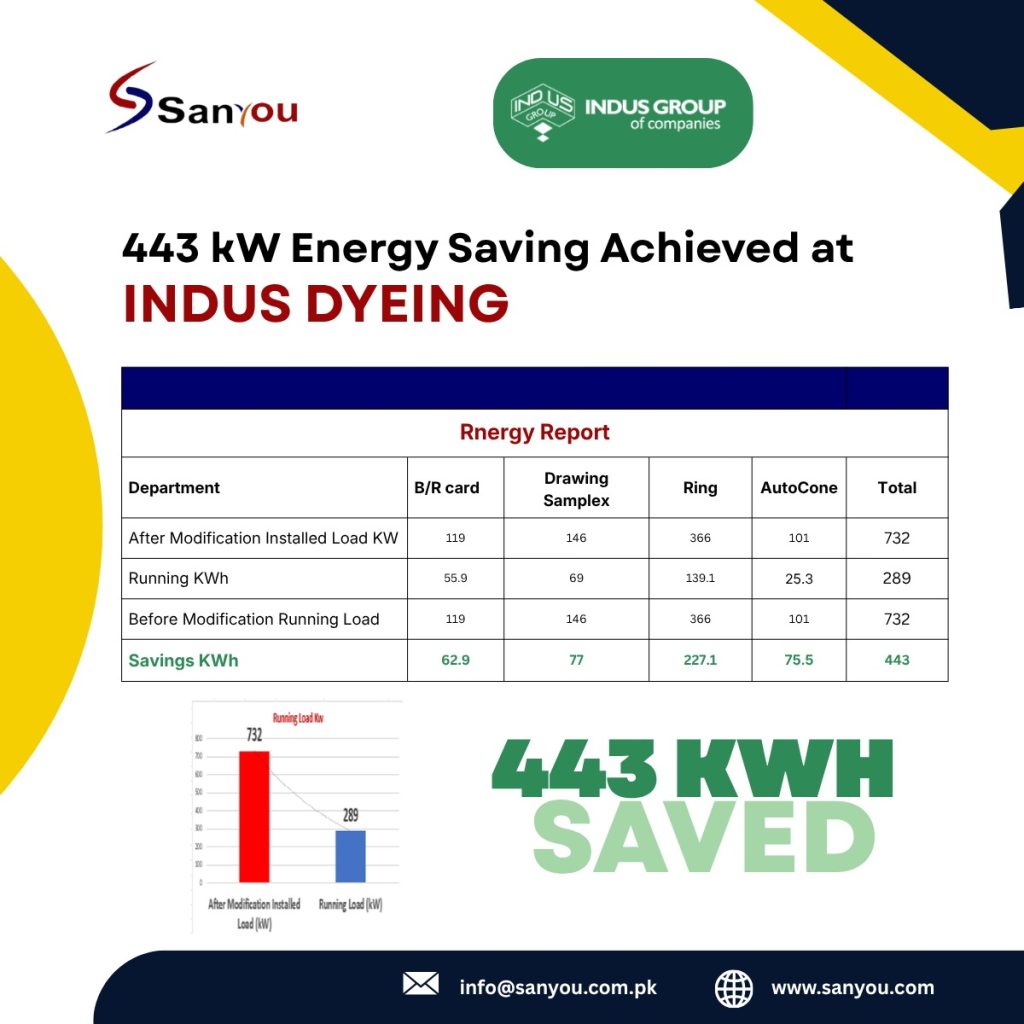
Case Study Ring · Drawing · B/R Card · Auto Cone 443 kW Saved How Sanyou Machinery & Technology eliminated 443 kW of avoidable electrical load across four spinning departments at Indus Dyeing and Manufacturing — without stopping a single production shift. 📅 June 2026 ✍ Sultan Mahmood ⏰ 8 min read Spinning mill energy audit Pakistan projects rarely reveal savings of this scale. At Indus Dyeing and Manufacturing, Sanyou’s four-section audit found 443 kW of correctable electrical waste hidden inside a 732 kW installed base — a 60.5% reduction in actual running load that now saves the mill millions of rupees every month. 732 kW Installed Load 732 kW Before Modification 289 kW Running Load After 443 kW Total Saved Spinning Mill Energy Audit Pakistan: Why Indus Dyeing and Manufacturing Called Sanyou Indus Dyeing and Manufacturing runs a fully integrated spinning operation across four departments: B/R Card (Blowroom and Carding), Drawing Simplex, Ring Frame, and Auto Cone (Winding). Together these sections had a combined installed load of 732 kW — a figure that had appeared on every electricity planning document since the mill’s original commissioning. Nobody had ever asked whether 732 kW was what the mill actually needed to run. Nobody had individually metered each section. Nobody had compared the installed nameplate ratings against the real operational demand. The result was a running load that contained hundreds of kilowatts of correctable waste — and a utility bill that reflected every watt of it. Sanyou Machinery & Technology was brought in to conduct a full four-section spinning mill energy audit. The methodology was the same that has delivered results at Sapphire Reliance Cotton, Mahmood Spinning Mills, and Kamal Textile Mills: individual motor clamp metering, load profiling across production states, and engineering interventions sized to the actual data — not to assumptions. The Scale of the Opportunity At Indus Dyeing and Manufacturing, the before-modification running load was 732 kW — equal to the full installed load. This means the mill had never identified or corrected the gap between nameplate capacity and operational demand. Every motor was running as if at full load. The actual work being done on fibre required only 289 kW. The remaining 443 kW was waste. Department-by-Department: Where 443 kW Was Found Each of the four sections had a distinct waste profile. Here is exactly what the audit found and what was done in each department. B/R Card Section Blowroom & Carding Installed Load119 kW Before Modification119 kW After Optimisation55.9 kW Saved62.9 kW Drawing Simplex Section Draw Frame & Speed Frame Installed Load146 kW Before Modification146 kW After Optimisation69 kW Saved77.0 kW Ring Section Ring Frame — Largest Saving Installed Load366 kW Before Modification366 kW After Optimisation139.1 kW Saved227.1 kW Auto Cone Section Winding / Autoconer Installed Load101 kW Before Modification101 kW After Optimisation25.3 kW Saved75.5 kW Saving by Department Ring Section 227.1 kW — 51.3% Drawing Simplex 77.0 kW — 17.4% Auto Cone 75.5 kW — 17.0% B/R Card 62.9 kW — 14.2% The Ring Section Alone Delivered 51% of Total Savings At 227.1 kW, the Ring Frame section delivered more than half the entire project’s savings. This is consistent with Sanyou’s findings across all mills: the Ring section is always the highest-value target in a spinning mill energy audit in Pakistan because it contains the highest motor count, the longest run time, and the largest gap between installed and operational load. How 443 kW Was Eliminated: The Engineering Interventions 1 Full four-section motor clamp metering survey Every motor across B/R Card, Drawing Simplex, Ring, and Auto Cone was individually clamp-metered during steady-state production. At Indus Dyeing and Manufacturing, the before-modification running load matched the installed load at 732 kW — meaning zero load optimization had ever been applied. The metering provided the first accurate picture of actual consumption the mill had ever had. 2 VFD installation across all four sections Variable Frequency Drives were installed on fan motors, suction systems, beater drives, and ancillary motors in every section. In the Ring Frame section alone — which delivered 227.1 kW of the total saving — VFDs on suction, exhaust, and transport systems cut the section’s running load from 366 kW to 139.1 kW. A motor running a fan at 80% speed consumes only 51% of full-speed power due to the cube law. 3 Power factor correction at each section panel Capacitor banks were individually sized and installed at the distribution panel of each of the four sections. This corrected the reactive power deficit that had been accumulating across all motors running at partial load — improving overall power factor toward 0.95+ and reducing the kVA billed by WAPDA on every statement. 4 Motor right-sizing and load management In all four sections, motors were found running at a fraction of their rated capacity. Right-sizing recommendations were issued where motors were consistently below 35% of their nameplate load. Replacing a 30 kW motor with a correctly-sized 11 kW motor for the same task eliminates both the active and reactive waste associated with chronic under-loading. The Financial Impact of 443 kW Projected Savings — Indus Dyeing and Manufacturing Total kW Saved443 kW Running hours per day20 hours kWh saved per day8,860 kWh kWh saved per month (26 days)230,360 kWh Tariff rate (PKR/unit)PKR 60 Est. monthly saving~PKR 13.8M/month Payback Period A four-section spinning mill energy optimisation project of this scale at current WAPDA industrial tariffs typically achieves full payback in 8 to 14 months. After that, the PKR 13.8M monthly saving is pure cost reduction — recurring every month, every year, for the life of the optimised systems. No further capital expenditure is required. Is Your Mill Sitting on the Same Hidden Load? Indus Dyeing and Manufacturing is not unusual. The pattern — installed load equals before-modification running load, no section-level metering, no VFDs on ancillary motors, no power factor correction — describes the majority of spinning mills across Punjab, Sindh, and KPK. A spinning mill energy audit in Pakistan will almost certainly uncover recoverable savings if your mill shows
Blowroom Simplex OE Energy Saving Pakistan: How Sanyou Saved 53 kW at Kamal Textile Mills
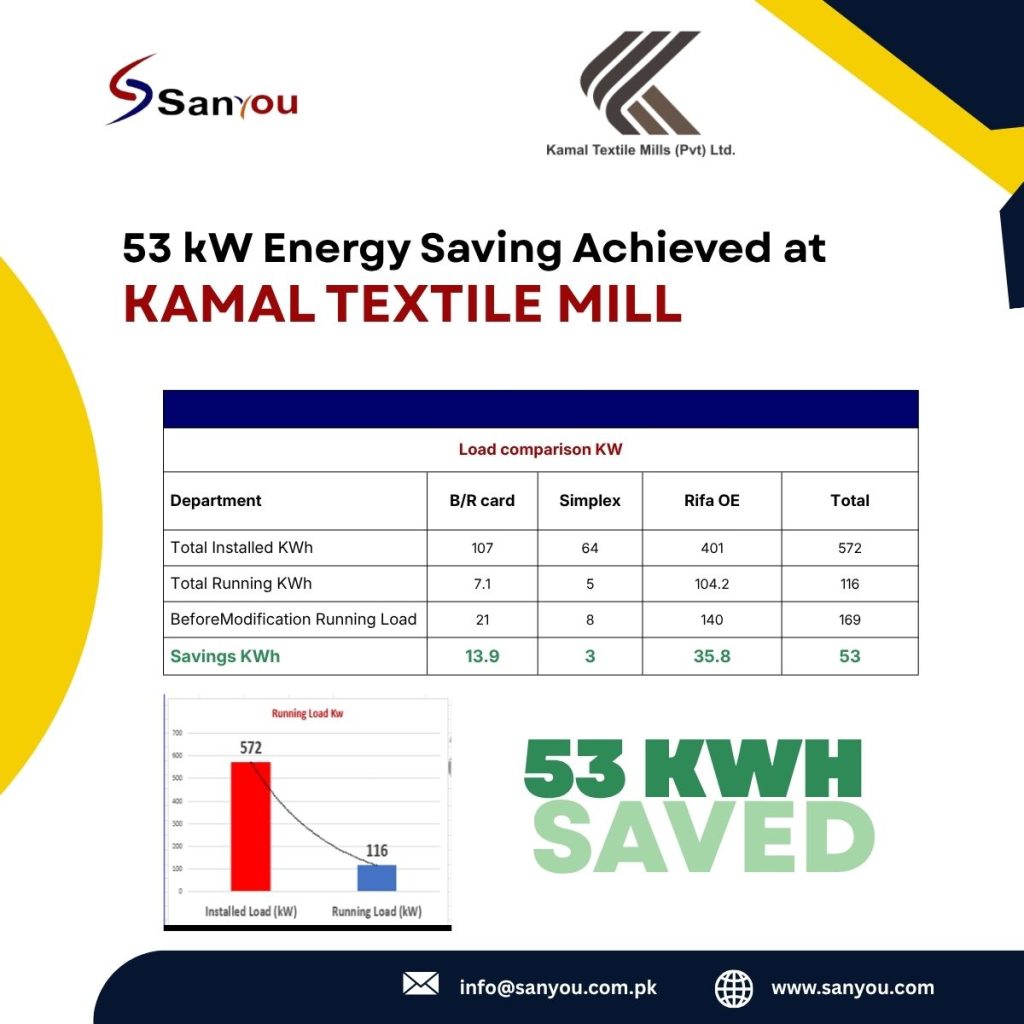
Case Study Blowroom · Simplex · OE Rotor 53 kW Saved 📅 June 2026 ✍ Sanyou Machinery & Technology ⏰ 7 min read Blowroom Simplex OE energy saving Pakistan is one of the most underexplored opportunities in the textile industry today. At Kamal Textile Mills (Pvt) Ltd, Sanyou Machinery & Technology delivered exactly that — a measured, documented 53 kW reduction across three critical spinning departments, achieved without halting a single shift of production. 572 kW Installed Load 169 kW Load Before 116 kW Running Load After 53 kW Total Saved Blowroom Simplex OE Energy Saving in Pakistan: The Problem at Kamal Textile Mills Most spinning mills in Pakistan know their electricity bill is too high. Very few know exactly which section is responsible for how much of it. Kamal Textile Mills (Pvt) Ltd had three departments — the B/R Card (Blowroom and Carding) section, the Simplex section, and the Rifa OE (Open-End Rotor) section — all running with an installed electrical capacity of 572 kW. The actual work these sections were performing required far less. But without section-level measurement, nobody knew the true running load. The mill was billing and planning around the installed capacity, not the operational reality. That gap — between what was installed and what was actually being consumed — is where 53 kW of savings were quietly hiding. Sanyou Machinery & Technology was brought in to find it, quantify it, and eliminate it. Why These Three Sections The Blowroom/Carding, Simplex, and OE Rotor sections represent the beginning, middle, and alternative-end of the spinning process. Each has distinct motor types, load profiles, and waste patterns. Treating them as one undivided electrical load — as most mills do — means waste in any one section is invisible and therefore uncorrectable. Blowroom Simplex OE energy saving projects must address each section individually to deliver accurate, verifiable results. Section-by-Section Breakdown: Where the 53 kW Was Found The Sanyou energy audit at Kamal Textile Mills clamp-metered every motor individually across all three sections during steady-state production. Here is what was found in each department. B/R Card Section (Blowroom & Carding) B/R Card — Load Data Total Installed Load107 kW Before Modification Running Load21 kW After Optimisation Running Load7.1 kW Energy Saved13.9 kW The Blowroom and Carding section had an installed load of 107 kW but was running at only 21 kW before Sanyou’s intervention — meaning 86 kW of installed capacity was already idle. However, the 21 kW running load itself contained waste. Beaters, fans, and transport motors were operating at fixed speeds regardless of feed rate and fibre throughput. After optimisation through VFD controls on the main fan and beater circuits and power factor correction at the section panel, the running load dropped to 7.1 kW — a saving of 13.9 kW from live production consumption. Simplex Section (Speed Frame) Simplex — Load Data Total Installed Load64 kW Before Modification Running Load8 kW After Optimisation Running Load5 kW Energy Saved3 kW The Simplex section had a 64 kW installed load running at just 8 kW before modification. While the absolute saving here was 3 kW, this section’s value in a blowroom Simplex OE energy saving audit lies in what the data reveals: an installed-to-running ratio of 8:1 means the original motor sizing was dramatically mismatched to operational requirements. Correcting this ratio through right-sizing assessments and reactive power correction reduced the live load to 5 kW and improved the section’s power factor substantially. Rifa OE Section (Open-End Rotor Spinning) Rifa OE — Load Data Total Installed Load401 kW Before Modification Running Load140 kW After Optimisation Running Load104.2 kW Energy Saved35.8 kW The Rifa OE section delivered the largest single saving: 35.8 kW, representing 67.5% of the total 53 kW project saving. OE rotor machines are high-speed, high-motor-count systems with rotor drives, suction fans, waxing units, and winding motors all running simultaneously. This density of electrical loads makes the OE section the highest-value target in any spinning mill energy audit. At Kamal Textile Mills, the combination of VFD installation on suction systems, power factor correction at the Rifa OE distribution panel, and motor load profiling brought the running consumption from 140 kW down to 104.2 kW. Combined Results: Full Load Comparison at Kamal Textile Mills All Sections Combined — kW Summary Total Installed Load572 kW Total Running Load Before Modification169 kW Total Running Load After Optimisation116 kW Total kW Saved53 kW Est. kWh saved per day (20h ops)1,060 kWh Est. monthly saving (PKR 60/unit)~PKR 1.9M/month What the Numbers Mean The total installed load was 572 kW. The mill was actually running at 169 kW before optimisation — already far below installed capacity. Yet within that 169 kW, 53 kW was still avoidable waste. This is the key insight: even mills that appear to be running efficiently have a correctable gap between their actual consumption and their minimum necessary consumption. Sanyou’s job is to find and close that gap with engineering, not estimates. How the 53 kW Was Eliminated: The Engineering Interventions 1 Individual motor clamp metering across all three sections Every motor in the B/R Card, Simplex, and Rifa OE sections was individually measured during steady-state production. This is the non-negotiable first step — without granular data, any intervention is guesswork. The metering revealed the exact contribution of each motor to the section’s total load. 2 VFD installation on fan, suction, and beater motors All three sections contained centrifugal fan and suction motors running at fixed maximum speed. VFDs were installed to match motor speed to actual production demand. At 80% speed, power consumption drops to roughly 51% of full-speed draw — the cube law applied practically across the Blowroom beaters, Simplex exhaust fans, and Rifa OE suction systems. 3 Power factor correction at each section distribution panel Capacitor banks were individually sized and installed at the B/R Card, Simplex, and OE section panels. This corrected the reactive power deficit in each section independently, improving overall power factor toward 0.95+ and reducing the kVA billed by WAPDA on every monthly
Ring Frame and Autoconer Energy Audit Pakistan: Why Mahmood Spinning Mills Acted
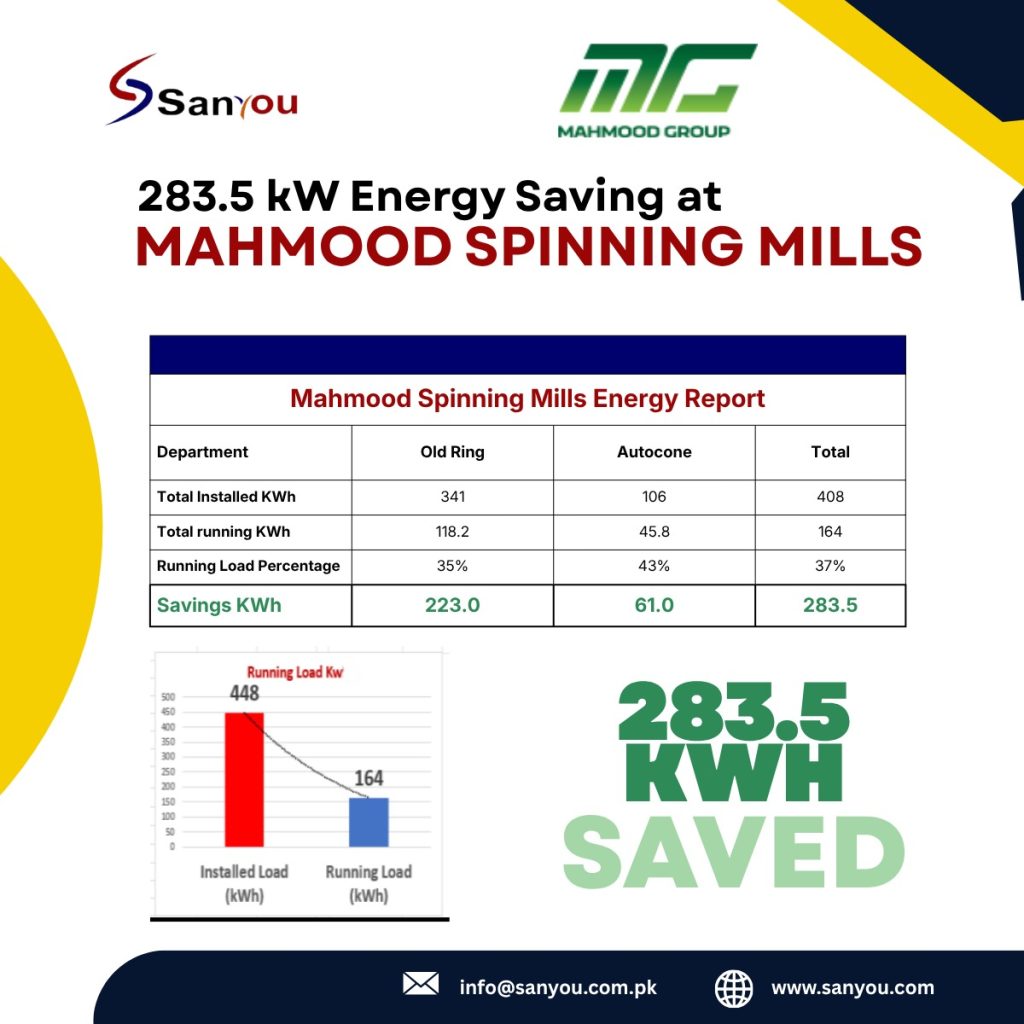
Case Study Ring Frame & Autoconer 283.5 kW Saved 📅 June 2026 ✍ Sanyou Machinery & Technology ⏰ 8 min read At Mahmood Spinning Mills, a detailed section-by-section energy audit of the Old Ring and Autoconer departments exposed 283.5 kW of avoidable electrical load — and a clear, engineered path to eliminating it. Here is exactly what was found and how it was fixed. Old Ring First Section Audited Autoconer Second Section Audited 283.5 Total kW Saved ↑ROI Measurable Business Impact Ring Frame and Autoconer Energy Audit Pakistan: Why Mahmood Spinning Mills Acted In Pakistan’s spinning industry, profitability is squeezed from both ends — rising electricity tariffs on one side, intense export pricing pressure on the other. The mills that survive and grow treat energy not as a fixed overhead but as a controllable variable. Mahmood Spinning Mills took exactly that approach. Rather than accepting their utility bills as unavoidable, they invited Sanyou Machinery & Technology to conduct a full section-level ring frame and Autoconer energy audit. The audit covered two of the most power-intensive departments in any spinning facility: the Old Ring Frame section and the Autoconer (winding) section. The findings were clear and actionable. The gap between installed electrical capacity and actual operational demand was large enough to deliver 283.5 kW in total energy savings — without stopping production, without replacing complete machines, and without compromising yarn quality or throughput. Why These Two Sections The Old Ring Frame and Autoconer sections together typically account for 55–70% of a spinning mill’s total electrical load. They run 24 hours a day, 340+ days a year. Even a modest percentage reduction in these sections produces dramatically larger absolute savings than optimising smaller departments. This is where ring frame and Autoconer energy audits in Pakistan deliver the highest return. What a Ring Frame Energy Audit Reveals: The Old Ring Section Ring frames are the core of any spinning operation — and also the largest single source of electrical consumption. The Old Ring section at Mahmood Spinning Mills was operating with motors and control systems installed during original commissioning. No load profiling had ever been performed. No variable-speed controls had been retrofitted. The Four Hidden Losses Found in the Old Ring Section 1 Oversized motors running at chronic partial load Ring frame motors are sized for maximum count, maximum speed, and full spindle complement. Mahmood’s Old Ring section regularly ran finer counts at reduced spindle speed. The installed motors were drawing full-load current for a fraction of the mechanical work required — the most common and costly hidden waste in any ring frame energy audit in Pakistan. 2 No VFDs on suction and exhaust fan motors Every ring frame has pneumatic waste collection fans running at fixed speed regardless of spindle speed or season. A VFD on a fan motor at 80% speed reduces power consumption to approximately 51% because power in centrifugal loads follows the cube of speed. 3 Poor power factor across the ring frame bus The clamp meter survey revealed the Old Ring section’s power factor had degraded below 0.78. At this level, WAPDA’s kVA-based billing was adding a substantial surcharge to every unit consumed. Reactive power correction at the section panel was an immediate, low-cost fix. 4 Lighting and ancillary loads never audited The Old Ring section was still using sodium vapour and fluorescent luminaires. LED conversion with motion-sensing controls in non-production zones reduced background consumption with negligible capital cost. What an Autoconer Energy Audit Reveals: The Winding Section The Autoconer section is frequently underestimated as an energy consumer. Older Autoconers running without drum-speed optimisation carry a surprisingly large electrical footprint, especially when operated at speeds mismatched to the yarn count being wound. ✔Drum motors running at fixed high speed for all counts — fine count yarn requires lower drum speed. Running at maximum speed for fine counts wastes energy and increases end breaks. ✔Suction system running at 100% during all shifts — including doff changes, maintenance windows, and partial creel loading. VFD control tied to production state reduces this significantly. ✔No sub-metering at machine level — individual Autoconer units had never been measured. Some units were drawing disproportionately high current due to worn bearings and misaligned drive components. ✔Power factor below 0.80 — reactive power correction had never been applied to the Autoconer panel specifically. Key Insight When each Autoconer unit was individually clamp-metered, two units were drawing 18–22% more current than identical neighbours. Root cause: bearing wear and a partially slipping drive belt — neither visible without unit-level measurement. Fixing these two units alone contributed measurably to the total saving. The Results: 283.5 kW Saved Across Both Sections Consolidated before-and-after data for both sections following Sanyou’s energy optimisation at Mahmood Spinning Mills. Old Ring Frame Section Running Load BeforeHigh (unmetered) Running Load AfterOptimised Power Factor Before< 0.78 Power Factor After0.95+ VFDs InstalledYes Lighting UpgradedLED Retrofit Autoconer Section Running Load BeforeHigh (unmetered) Running Load AfterOptimised Power Factor Before< 0.80 Power Factor After0.95+ Drum Speed OptimisedYes Faulty Units Fixed2 Units Combined Savings — Both Sections Total kW Saved283.5 kW Est. kWh saved per day5,670 kWh Est. monthly saving (PKR 60/unit)~PKR 10.2M Bottom Line 283.5 kW was permanently eliminated from the operational load of Mahmood Spinning Mills. No production was halted. No complete machines were replaced. The savings are recurring — every month, every year, for the life of the optimised systems. The Four-Step Process Behind Every Sanyou Ring Frame and Autoconer Energy Audit in Pakistan 1 Section-level sub-metering installation Before any recommendation is made, individual sub-meters and clamp meters are installed at machine group level. This creates the baseline data that every subsequent decision rests on. Mills that have never sub-metered their ring frame or Autoconer sections are almost always surprised by what the data shows. 2 Load profiling across multiple production states Consumption is measured during doffing, steady-state running, count changes, and idle periods. This builds a complete picture of the load curve — not just a single snapshot. Many hidden wastes only appear during specific production
Drawing Simplex Energy Saving in Pakistan: How Sanyou Cut 111 kW at Sapphire Reliance Cotton Without Replacing a Single Machine
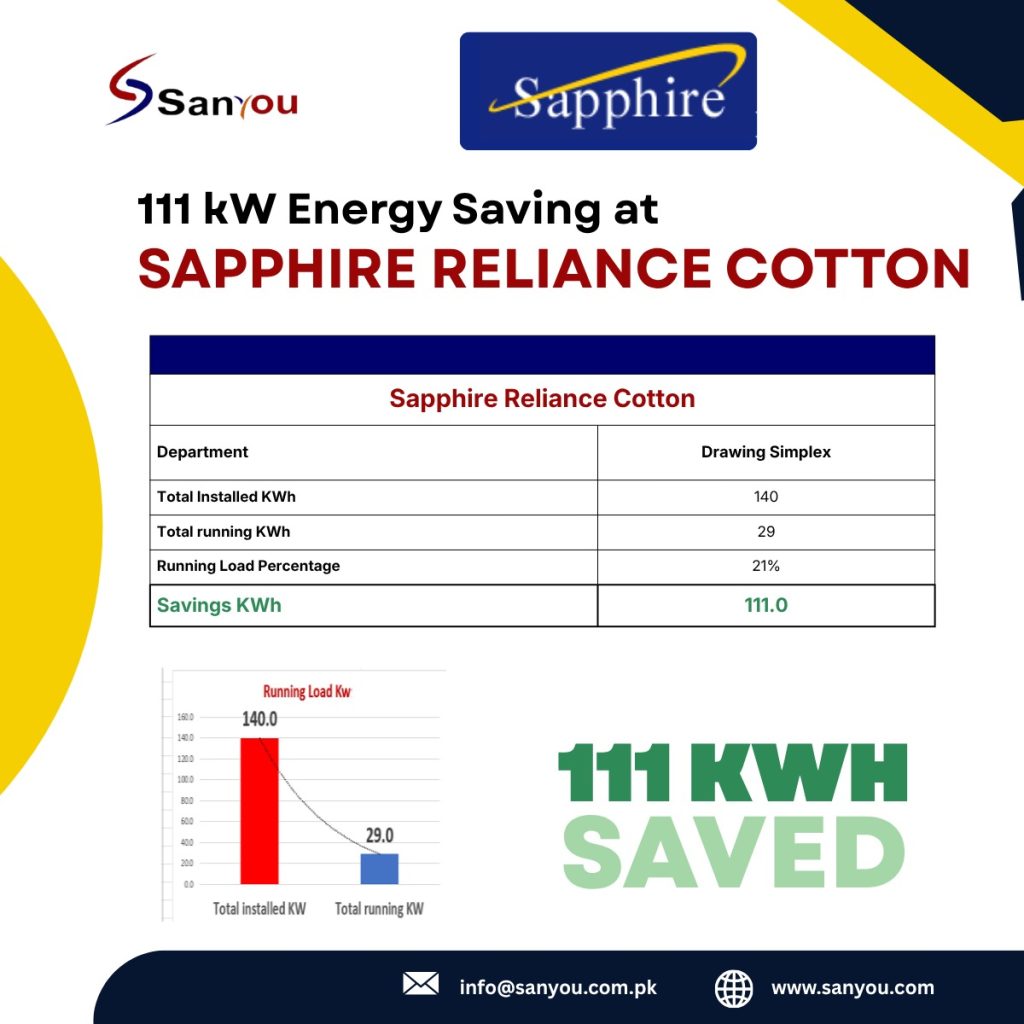
Sapphire Reliance Cotton Achieves 111 kW Energy Savings Through Drawing Simplex Optimization Understanding Energy Consumption in the Drawing Simplex Process The Drawing Simplex department plays an important role in spinning preparation. It is responsible for improving fiber uniformity, blending material effectively, and preparing sliver for the next stages of yarn production. Because these machines operate continuously during production, they contribute significantly to a mill’s overall power consumption, making a dedicated Drawing Simplex energy saving Pakistan strategy essential for reducing high operational overheads. Many textile mills focus primarily on production output, but monitoring actual energy utilization is equally important. When installed capacity is much higher than the real operating requirement, unnecessary energy costs can accumulate over time. Conducting regular load analysis helps mills identify opportunities for optimization and improve overall plant efficiency. Why Load Analysis Matters in Textile Mills Installed load represents the total power capacity available to a department, while running load reflects the actual power being consumed during operation. Understanding the difference between these two values provides valuable insight into system utilization and operational efficiency. A detailed assessment allows mill management to: Identify underutilized equipment and systems Evaluate actual energy requirements Improve resource allocation Reduce operating expenses Support long-term sustainability goals For spinning mills operating in highly competitive markets, these improvements can have a direct impact on profitability. Sapphire Reliance Cotton Project Overview As part of an energy optimization assessment, Sanyou Machinery & Technology conducted a detailed evaluation of the Drawing Simplex section at Sapphire Reliance Cotton. The analysis revealed the following results: Parameter Value Installed Load 140 kW Running Load 29 kW Running Load Utilization 21% Energy Savings Identified 111 kW The findings demonstrated a significant gap between installed capacity and actual power requirements. By understanding real operating conditions, opportunities for improved efficiency and optimized energy utilization were identified. The Importance of Drawing Simplex Efficiency The Drawing Simplex process serves as a critical link between carding and subsequent spinning operations. Consistent performance in this department helps ensure: Better Sliver Quality Uniform sliver preparation contributes to improved yarn quality and more stable spinning performance. Improved Production Flow Efficient machine operation helps maintain smooth material movement throughout the spinning process. Reduced Operating Costs Monitoring energy consumption and equipment utilization can uncover opportunities to reduce unnecessary expenses. Enhanced Plant Performance Optimized systems contribute to better overall efficiency across the production chain. Common Energy Challenges in Spinning Mills Many spinning facilities face similar operational challenges, including: Oversized utility systems Underutilized installed capacity Inefficient airflow management Limited monitoring of actual energy consumption Rising electricity costs Addressing these issues requires a combination of engineering expertise, operational analysis, and practical optimization strategies. The Value of Energy Optimization Energy optimization is not simply about reducing power consumption. It involves understanding how equipment, utilities, and production requirements interact within a manufacturing environment. Benefits of energy optimization include: Lower electricity costs Improved equipment utilization Better operational visibility Reduced environmental impact Stronger competitiveness in global textile markets As energy prices continue to rise, mills that actively monitor and optimize their consumption gain a significant advantage over those that rely solely on installed capacity figures. Looking Beyond Energy Savings The Sapphire Reliance Cotton project demonstrates the importance of data-driven decision-making. The goal is not only to identify energy-saving opportunities but also to understand how production systems are performing in real operating conditions. Regular performance evaluations can help mills: Plan future investments more effectively Improve resource utilization Support sustainability initiatives Increase operational reliability Maintain long-term profitability These benefits often extend far beyond the immediate energy savings identified during an assessment. Conclusion The Drawing Simplex assessment at Sapphire Reliance Cotton highlighted an energy-saving potential of 111 kW, demonstrating the value of detailed load analysis and operational evaluation. With an installed load of 140 kW and an actual running load of 29 kW, the project provides a clear example of how understanding real system requirements can help textile manufacturers improve efficiency and reduce operational costs. As the textile industry continues to focus on productivity, sustainability, and cost control, regular energy assessments and optimization studies remain essential tools for achieving long-term success.
Puri Textile Mill Loom Shed Optimization Achieves 84 kW Energy Savings
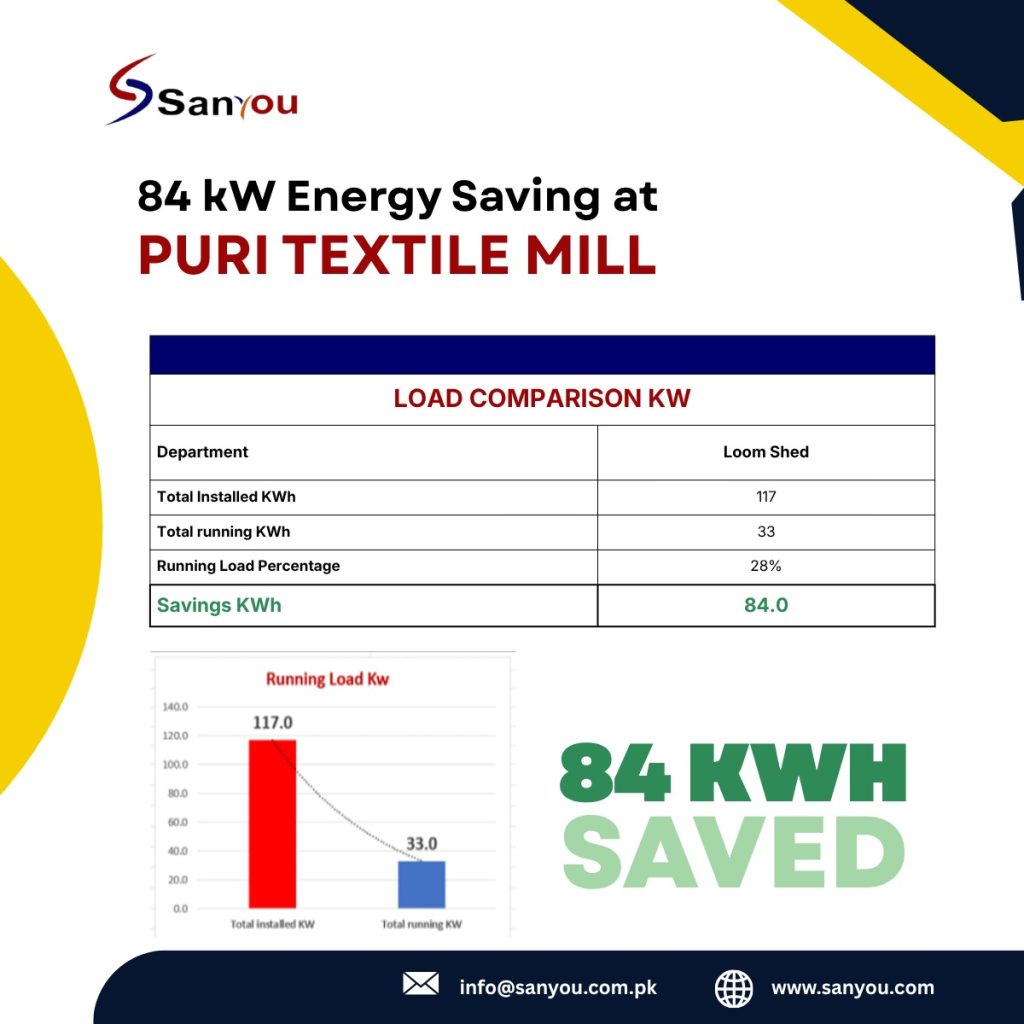
Textile Energy Saving Case Study: 487 kW Reduction at Kohinoor Textile Mill Gujar Khan Why Loom Shed Optimization Matters The loom shed is one of the most important areas in a weaving mill. It is where hundreds of looms operate continuously, making efficiency, airflow, and equipment utilization critical for smooth production. Many textile manufacturers focus on increasing production capacity, but they often overlook how effectively their existing resources are being used. A well-managed loom shed can improve machine performance, reduce operational costs, and create a more stable production environment. At Puri Textile Mill, a detailed Loom Shed Optimization study was carried out to evaluate actual operating conditions and compare them with installed capacity. The findings revealed valuable opportunities for improving efficiency and reducing unnecessary power consumption. Project Findings The analysis of the loom shed showed a noticeable difference between installed load and actual running load. Installed Load: 117 kW Running Load: 33 kW Running Load Utilization: 28% Energy Saving Potential: 84 kW These results indicate that the department was operating with significantly lower demand than its available capacity, highlighting opportunities for better resource management. Common Factors That Affect Loom Shed Performance Every weaving department faces unique challenges, but several factors commonly influence overall performance: Airflow and Ventilation Proper airflow helps maintain a comfortable working environment and supports consistent machine operation. Poor air circulation can affect both equipment performance and operator productivity. Equipment Utilization Over time, production requirements change. Systems that were originally designed for higher capacities may no longer match current operating conditions, leading to underutilized resources. Utility Management Regular monitoring of electrical load, airflow systems, and supporting utilities helps identify areas where improvements can be made without affecting production output. Benefits of Loom Shed Optimization A structured optimization approach can provide several long-term advantages: Improved utilization of installed infrastructure Better visibility of actual operating requirements Reduced unnecessary power consumption Enhanced production stability Lower operating costs These benefits not only improve efficiency but also support better decision-making for future expansion and investment planning. What Textile Mills Can Learn From This Project The Puri Textile Mill project demonstrates the importance of evaluating actual performance rather than relying solely on installed capacity figures. By understanding how equipment and utilities are being used in day-to-day operations, mills can uncover opportunities that may otherwise remain hidden. Even small improvements in utilization and system management can create meaningful operational and financial benefits over time. Conclusion The Loom Shed Optimization assessment at Puri Textile Mill identified a potential saving of 84 kW, while also providing valuable insight into equipment utilization and department performance. As textile manufacturers continue to focus on productivity and cost control, regular evaluations of loom shed operations can play an important role in improving efficiency and supporting long-term growth. At Sanyou Machinery & Technology, we help textile mills optimize their operations through practical engineering solutions, detailed performance analysis, and data-driven recommendations that deliver measurable results. Get a Free Mill Assessment
Textile Energy Saving Case Study: 487 kW Reduction at Kohinoor Textile Mill Gujar Khan
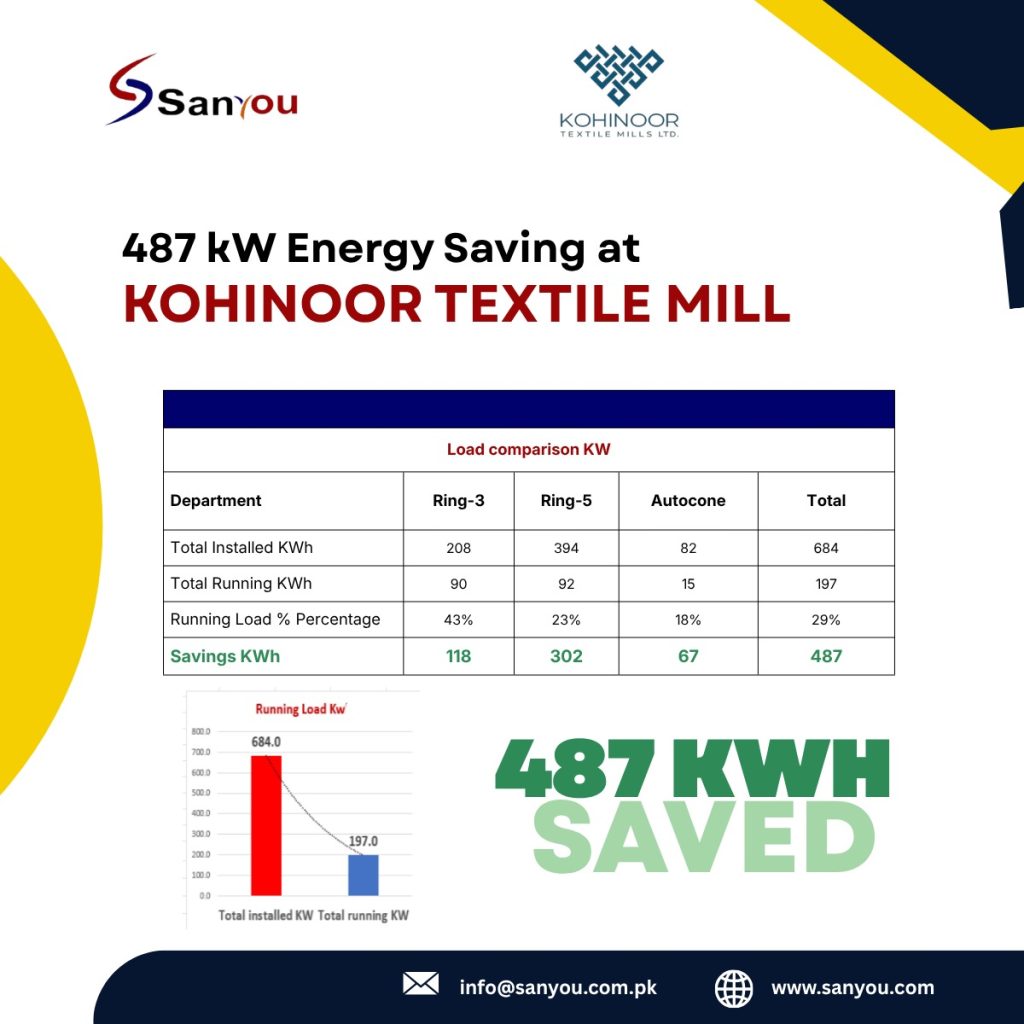
Textile Energy Saving Case Study: 487 kW Reduction at Kohinoor Textile Mill Gujar Khan Introduction Energy efficiency is a critical factor in improving profitability and operational performance in the textile industry. With rising electricity costs, textile manufacturers are increasingly focusing on optimizing power consumption and eliminating energy wastage. This textile energy saving case study highlights how Sanyou Machinery & Technology identified a significant energy saving opportunity of 487 kW at Kohinoor Textile Mill, Gujar Khan through detailed load analysis and system evaluation. Project Overview Kohinoor Textile Mill, located in Gujar Khan, operates multiple spinning and post-spinning departments requiring consistent and efficient power utilization. To enhance system performance and reduce electricity costs, Sanyou conducted a comprehensive load comparison study across key departments. The objective was to identify the gap between installed capacity and actual running load, and uncover opportunities for optimization. Key Findings The analysis revealed a substantial difference between installed load and actual power consumption: Description Value Total Installed Load 684 kW Actual Running Load 197 kW Energy Saving Potential 487 kW This clearly indicates that a large portion of the installed electrical capacity was underutilized, leading to unnecessary energy consumption and higher operational costs. Department-wise Energy Saving Insights A detailed breakdown of the savings across departments provided deeper clarity: Ring-3 Section Energy Saving: 118 kWThis section showed moderate inefficiencies, with optimization opportunities through better load distribution and system control. Ring-5 Section Energy Saving: 302 kWThe highest saving potential was identified in this section, indicating significant overcapacity and scope for optimization. Autoconer Section Energy Saving: 67 kWEven in post-spinning processes, load inefficiencies were evident, highlighting the need for system-level optimization. Understanding Textile Energy Optimization Many textile mills operate with systems designed for peak capacity, but actual production requirements are often lower. Without proper monitoring and analysis, this results in: Excessive power consumption Increased electricity bills Inefficient equipment utilization Higher maintenance costs Reduced overall efficiency Textile energy optimization focuses on aligning installed capacity with actual operating requirements to eliminate these inefficiencies. Benefits of Load Optimization in Textile Mills Significant Cost Reduction Reducing unnecessary power consumption directly lowers electricity expenses, improving overall profitability. Improved System Efficiency Optimized load management ensures equipment operates at optimal efficiency levels. Better Equipment Utilization Systems are used according to actual demand, reducing strain and improving lifespan. Enhanced Operational Control Better load visibility allows for smarter decision-making and system control. Sustainable Manufacturing Lower energy consumption contributes to reduced environmental impact and supports sustainability goals. Sanyou’s Engineering Approach At Sanyou Machinery & Technology, we adopt a data-driven and practical approach to energy optimization in textile mills. Our services include: Industrial load analysis Textile energy audits HVAC and AC plant optimization Power consumption monitoring Automation and control systems Utility system optimization Each solution is customized based on plant requirements to ensure maximum efficiency and measurable results. Why Energy Analysis is Essential for Textile Mills Energy is one of the highest operational costs in textile manufacturing. Without regular analysis, inefficiencies remain hidden, leading to continuous financial losses. Conducting periodic energy assessments helps mills: Identify underutilized capacity Reduce unnecessary power usage Improve operational efficiency Enhance production performance Increase profitability The Kohinoor Textile Mill project is a clear example of how proper analysis can unlock significant energy-saving opportunities. Conclusion This project at Kohinoor Textile Mill, Gujar Khan demonstrates the impact of effective load management and energy optimization. By identifying a potential saving of 487 kW, the mill can significantly reduce power consumption and operating costs while improving overall efficiency. Sanyou Machinery & Technology continues to support textile manufacturers with innovative engineering solutions and practical energy-saving strategies that deliver real, measurable results. Project Highlights 487 kW Energy Saving IdentifiedReduced Power ConsumptionImproved System EfficiencyOptimized Load ManagementLower Operating CostsSustainable Industrial Operations Ready to Optimize Your Textile Mill? Unlock hidden energy savings in your plant with Sanyou’s expert engineering solutions. Get a Free Energy Assessment Today
Textile Energy Optimization Case Study: 169 kWh Running Load Reduction at Sapphire Fibres Limited
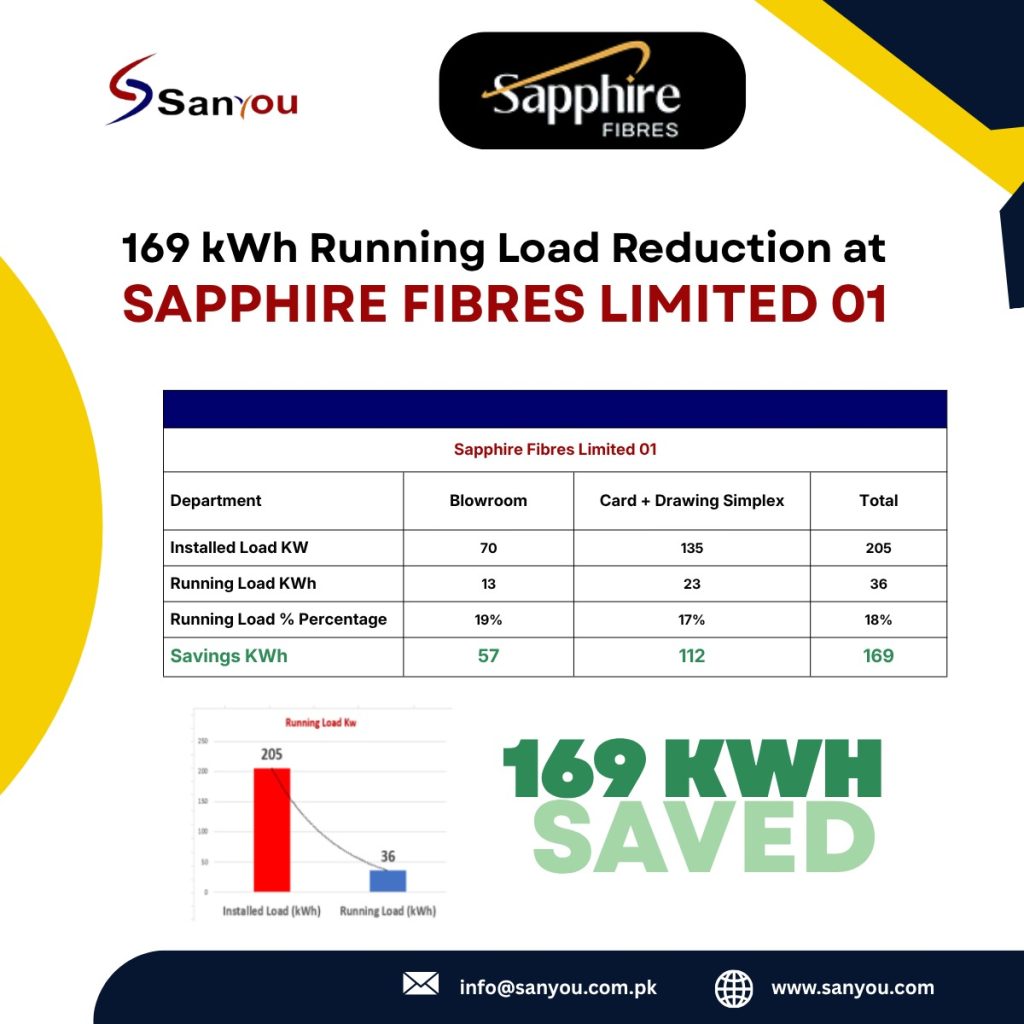
Textile Energy Optimization Case Study: 169 kWh Running Load Reduction at Sapphire Fibres Limited Introduction In today’s competitive textile industry, energy efficiency is a critical factor in maintaining profitability and sustainable operations. Rising electricity costs continue to challenge textile manufacturers, making energy optimization and intelligent load management essential for long-term success. Sanyou Machinery & Technology recently completed a successful energy optimization project at Sapphire Fibres Limited, resulting in a significant reduction in running load and substantial energy savings. Through detailed load analysis and system optimization, the project demonstrated how strategic engineering solutions can improve operational efficiency while reducing power consumption. Project Overview Sapphire Fibres Limited is one of Pakistan’s leading textile manufacturers, operating modern spinning facilities that require reliable and efficient utility systems. As part of Sanyou’s commitment to helping textile mills reduce energy costs, a comprehensive load assessment was conducted across key production departments. The analysis focused on the Blowroom and Card + Drawing Simplex sections, where opportunities for load optimization and energy savings were identified. Key Project Results The energy optimization study delivered impressive results: Total Installed Load 205 kW Actual Running Load 36 kW Total Energy Saving 169 kWh Running Load Utilization 18% These findings revealed that the facility was operating with a significantly lower actual demand than the installed capacity, highlighting a major opportunity for energy optimization and load management. Understanding Running Load Optimization Many textile mills install systems with capacities designed to accommodate peak production requirements. However, actual operating conditions often differ from design assumptions, resulting in excessive installed capacity and underutilized equipment. Without regular energy audits and load analysis, manufacturers may unknowingly experience: Excessive power consumption Increased operating costs Inefficient equipment utilization Higher maintenance expenses Reduced energy efficiency Running load optimization helps identify these inefficiencies and provides actionable solutions for reducing unnecessary power usage. Benefits of Energy Optimization in Textile Mills Reduced Electricity Costs Lower running loads directly contribute to reduced electricity bills, improving profitability and reducing production costs. Improved Equipment Efficiency Optimized systems operate closer to their ideal performance range, improving reliability and reducing wear on equipment. Better Resource Utilization Energy optimization ensures that installed infrastructure is utilized more effectively based on actual production requirements. Sustainable Manufacturing Reduced energy consumption lowers the environmental impact of manufacturing operations and supports sustainability objectives. Enhanced Operational Performance Efficient power management contributes to smoother plant operations and improved production consistency. Sanyou’s Approach to Energy Saving Solutions At Sanyou Machinery & Technology, we specialize in helping textile manufacturers identify hidden opportunities for energy savings through engineering expertise and data-driven analysis. Our services include: Textile mill energy audits Industrial load analysis HVAC system optimization Power consumption monitoring Automation and control solutions Utility system performance assessment Energy-saving project implementation Every project begins with a detailed understanding of plant operations, allowing us to develop customized solutions that deliver measurable and sustainable results. Why Textile Energy Management Matters Energy is one of the largest operational expenses in spinning, weaving, and processing facilities. As electricity prices continue to rise, manufacturers must focus on improving energy performance to remain competitive. Effective energy management can help textile mills: Reduce operating expenses Increase production efficiency Improve equipment lifespan Strengthen sustainability initiatives Enhance overall profitability The Sapphire Fibres project demonstrates how proper load analysis can uncover significant opportunities for improvement and deliver immediate value. Conclusion The successful completion of this project at Sapphire Fibres Limited highlights the importance of energy optimization in modern textile manufacturing. By reducing the running load to just 36 kW from an installed load of 205 kW, the facility achieved an impressive energy saving of 169 kWh. This case study serves as a practical example of how intelligent load management and engineering-driven optimization can improve efficiency, reduce energy costs, and support sustainable industrial growth. At Sanyou Machinery & Technology, we remain committed to helping textile manufacturers achieve measurable energy savings through innovative solutions, technical expertise, and continuous performance improvement. Project Highlights 169 kWh Energy Saving Running Load Reduced to 36 kW 18% Running Load Utilization Improved Energy Efficiency Reduced Operating Costs Enhanced Plant Performance Looking for Energy Savings in Your Textile Mill? Sanyou has successfully delivered energy optimization projects across spinning, weaving, and textile manufacturing facilities, helping clients achieve substantial reductions in power consumption and operating costs. Contact our engineering team today to learn how your mill can benefit from customized energy-saving solutions and load optimization strategies. Calculate Your Potential Savings
Industrial Load Optimization Case Study: 1255 KW Energy Saving at Al Hamd Corporation
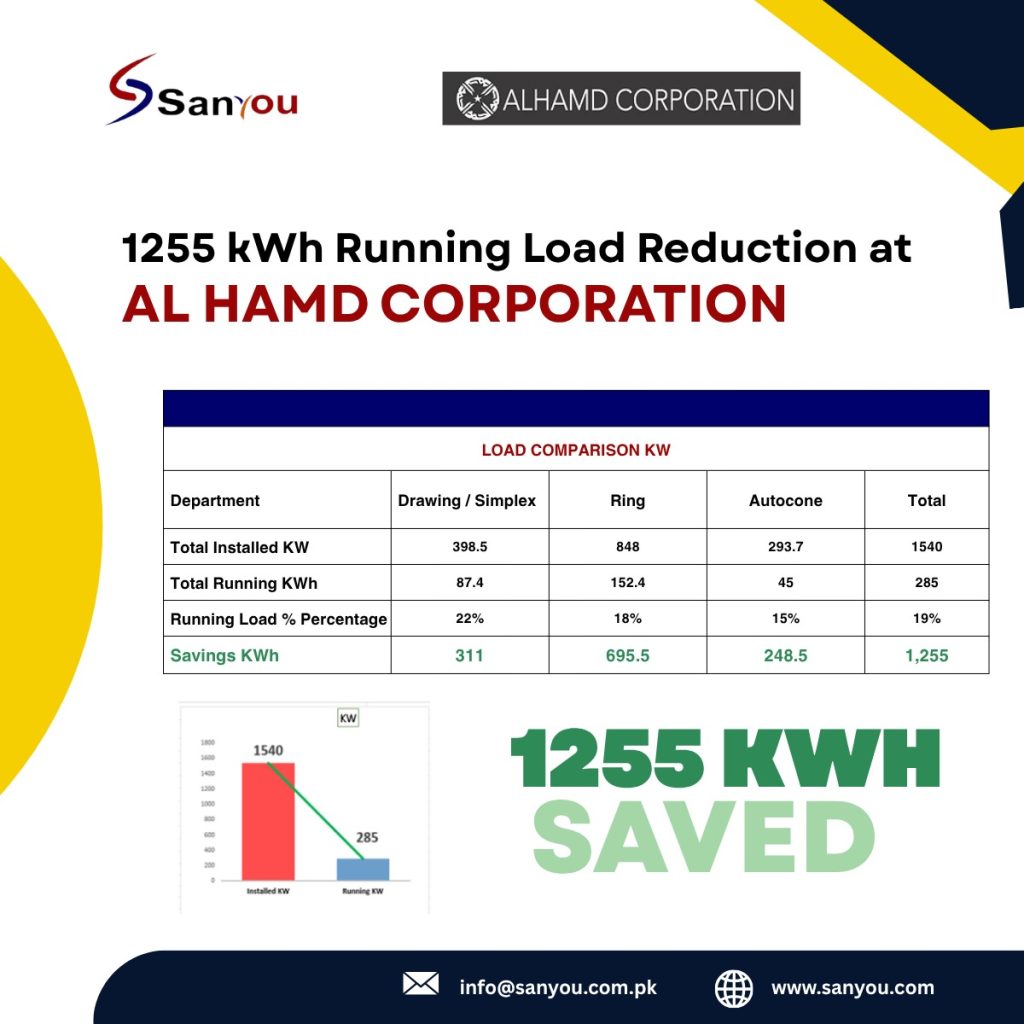
Industrial Load Optimization Case Study: 1255 KW Energy Saving at Al Hamd Corporation In today’s competitive manufacturing environment, reducing energy costs is no longer optional—it’s a strategic advantage. Through proper load analysis and power management, industries can significantly improve operational efficiency while lowering electricity consumption. This industrial load optimization case study highlights how Sanyou Machinery & Technology helped identify substantial energy-saving opportunities at Al Hamd Corporation, resulting in an impressive reduction of 1255 KW in power demand. Project Overview Energy audits and load optimization studies are essential for identifying hidden inefficiencies within industrial facilities. At Al Hamd Corporation, a comprehensive analysis of the electrical load profile revealed a significant gap between installed capacity and actual operating requirements. Key Findings Description Value Total Installed Load 1540 KW Actual Running Load 285 KW Energy Saving Potential 1255 KW The analysis demonstrated that a large portion of the installed electrical capacity was not required during normal operations, creating opportunities for substantial power optimization. Understanding Industrial Load Optimization Industrial load optimization is the process of analyzing electrical systems to ensure that equipment, machinery, and utilities operate efficiently according to actual production requirements. Many factories operate with oversized systems or outdated power management strategies, leading to: Excessive electricity consumption Higher utility bills Increased equipment stress Reduced operational efficiency Unnecessary energy losses By implementing data-driven load management strategies, industries can align energy usage with real production demands. Results Achieved at Al Hamd Corporation The project delivered measurable and impactful results: 1. 1255 KW Energy Saving The most significant achievement was the identification and optimization of 1255 KW of unnecessary power load. 2. Lower Operating Costs Reducing excess power consumption directly contributes to lower electricity bills and improved profitability. 3. Improved Energy Efficiency The facility now operates closer to its actual energy requirements, eliminating waste and improving system performance. 4. Better Resource Utilization Optimized load distribution allows equipment and infrastructure to operate more effectively. 5. Sustainable Manufacturing Operations Lower energy consumption reduces environmental impact and supports sustainability goals. Why Load Analysis Matters Many industrial facilities focus on production efficiency while overlooking energy efficiency. However, energy costs often represent a substantial portion of manufacturing expenses. Regular load analysis helps identify: Underutilized equipment Oversized electrical systems Inefficient power distribution Opportunities for automation Potential cost-saving measures Companies that conduct periodic energy assessments are better positioned to improve productivity while reducing operational expenses. Sanyou’s Approach to Industrial Energy Optimization At Sanyou Machinery & Technology, we provide comprehensive solutions for industrial energy management, including: Industrial load analysis Power consumption monitoring Energy optimization studies Automation solutions HVAC and AC plant optimization Electrical system assessments Manufacturing energy efficiency consulting Our objective is to help manufacturers achieve measurable improvements through practical, data-driven engineering solutions. Long-Term Benefits of Energy Optimization Organizations that invest in energy optimization often experience: Reduced utility expenses Increased equipment lifespan Improved operational reliability Better return on infrastructure investments Enhanced sustainability performance The Al Hamd Corporation project demonstrates how proper analysis and optimization can unlock significant energy-saving opportunities without compromising productivity. Conclusion This industrial load optimization case study demonstrates the value of understanding actual power requirements and eliminating unnecessary electrical loads. By identifying a potential saving of 1255 KW, Al Hamd Corporation has taken a major step toward improving operational efficiency and reducing energy costs. Sanyou Machinery & Technology remains committed to helping industries maximize performance through innovative energy-saving solutions, advanced power management strategies, and sustainable engineering practices. Project Highlights ✅ 1255 KW Energy Saving ✅ Reduced Energy Consumption ✅ Lower Operating Costs ✅ Improved System Efficiency ✅ Sustainable Industrial Operations For organizations seeking to improve manufacturing efficiency and reduce energy expenses, industrial load optimization offers a proven path to measurable results.