
Spinning Mill Energy Audit Pakistan: How Sanyou Saved 443 kW at Indus Dyeing and Manufacturing
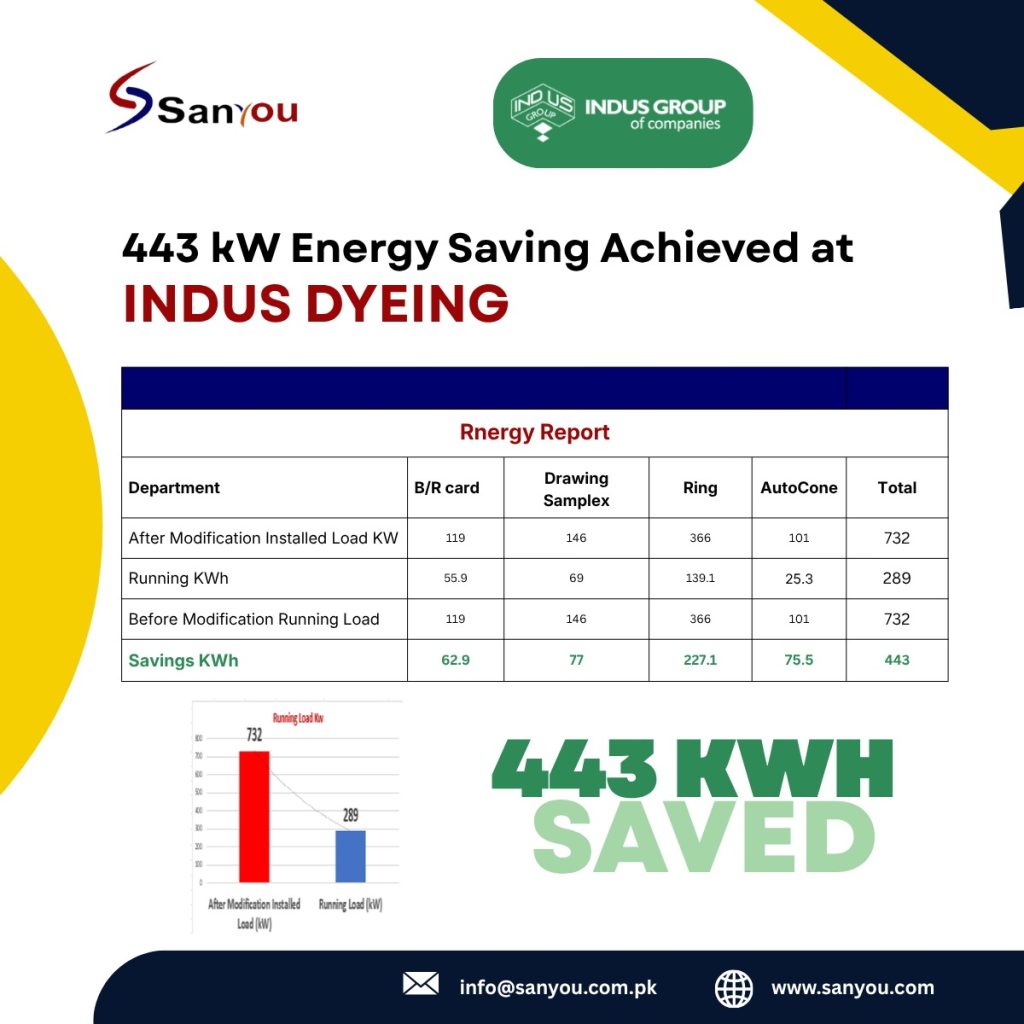
Case Study Ring · Drawing · B/R Card · Auto Cone 443 kW Saved How Sanyou Machinery & Technology eliminated 443 kW of avoidable electrical load across four spinning departments at Indus Dyeing and Manufacturing — without stopping a single production shift. 📅 June 2026 ✍ Sultan Mahmood ⏰ 8 min read Spinning mill energy audit Pakistan projects rarely reveal savings of this scale. At Indus Dyeing and Manufacturing, Sanyou’s four-section audit found 443 kW of correctable electrical waste hidden inside a 732 kW installed base — a 60.5% reduction in actual running load that now saves the mill millions of rupees every month. 732 kW Installed Load 732 kW Before Modification 289 kW Running Load After 443 kW Total Saved Spinning Mill Energy Audit Pakistan: Why Indus Dyeing and Manufacturing Called Sanyou Indus Dyeing and Manufacturing runs a fully integrated spinning operation across four departments: B/R Card (Blowroom and Carding), Drawing Simplex, Ring Frame, and Auto Cone (Winding). Together these sections had a combined installed load of 732 kW — a figure that had appeared on every electricity planning document since the mill’s original commissioning. Nobody had ever asked whether 732 kW was what the mill actually needed to run. Nobody had individually metered each section. Nobody had compared the installed nameplate ratings against the real operational demand. The result was a running load that contained hundreds of kilowatts of correctable waste — and a utility bill that reflected every watt of it. Sanyou Machinery & Technology was brought in to conduct a full four-section spinning mill energy audit. The methodology was the same that has delivered results at Sapphire Reliance Cotton, Mahmood Spinning Mills, and Kamal Textile Mills: individual motor clamp metering, load profiling across production states, and engineering interventions sized to the actual data — not to assumptions. The Scale of the Opportunity At Indus Dyeing and Manufacturing, the before-modification running load was 732 kW — equal to the full installed load. This means the mill had never identified or corrected the gap between nameplate capacity and operational demand. Every motor was running as if at full load. The actual work being done on fibre required only 289 kW. The remaining 443 kW was waste. Department-by-Department: Where 443 kW Was Found Each of the four sections had a distinct waste profile. Here is exactly what the audit found and what was done in each department. B/R Card Section Blowroom & Carding Installed Load119 kW Before Modification119 kW After Optimisation55.9 kW Saved62.9 kW Drawing Simplex Section Draw Frame & Speed Frame Installed Load146 kW Before Modification146 kW After Optimisation69 kW Saved77.0 kW Ring Section Ring Frame — Largest Saving Installed Load366 kW Before Modification366 kW After Optimisation139.1 kW Saved227.1 kW Auto Cone Section Winding / Autoconer Installed Load101 kW Before Modification101 kW After Optimisation25.3 kW Saved75.5 kW Saving by Department Ring Section 227.1 kW — 51.3% Drawing Simplex 77.0 kW — 17.4% Auto Cone 75.5 kW — 17.0% B/R Card 62.9 kW — 14.2% The Ring Section Alone Delivered 51% of Total Savings At 227.1 kW, the Ring Frame section delivered more than half the entire project’s savings. This is consistent with Sanyou’s findings across all mills: the Ring section is always the highest-value target in a spinning mill energy audit in Pakistan because it contains the highest motor count, the longest run time, and the largest gap between installed and operational load. How 443 kW Was Eliminated: The Engineering Interventions 1 Full four-section motor clamp metering survey Every motor across B/R Card, Drawing Simplex, Ring, and Auto Cone was individually clamp-metered during steady-state production. At Indus Dyeing and Manufacturing, the before-modification running load matched the installed load at 732 kW — meaning zero load optimization had ever been applied. The metering provided the first accurate picture of actual consumption the mill had ever had. 2 VFD installation across all four sections Variable Frequency Drives were installed on fan motors, suction systems, beater drives, and ancillary motors in every section. In the Ring Frame section alone — which delivered 227.1 kW of the total saving — VFDs on suction, exhaust, and transport systems cut the section’s running load from 366 kW to 139.1 kW. A motor running a fan at 80% speed consumes only 51% of full-speed power due to the cube law. 3 Power factor correction at each section panel Capacitor banks were individually sized and installed at the distribution panel of each of the four sections. This corrected the reactive power deficit that had been accumulating across all motors running at partial load — improving overall power factor toward 0.95+ and reducing the kVA billed by WAPDA on every statement. 4 Motor right-sizing and load management In all four sections, motors were found running at a fraction of their rated capacity. Right-sizing recommendations were issued where motors were consistently below 35% of their nameplate load. Replacing a 30 kW motor with a correctly-sized 11 kW motor for the same task eliminates both the active and reactive waste associated with chronic under-loading. The Financial Impact of 443 kW Projected Savings — Indus Dyeing and Manufacturing Total kW Saved443 kW Running hours per day20 hours kWh saved per day8,860 kWh kWh saved per month (26 days)230,360 kWh Tariff rate (PKR/unit)PKR 60 Est. monthly saving~PKR 13.8M/month Payback Period A four-section spinning mill energy optimisation project of this scale at current WAPDA industrial tariffs typically achieves full payback in 8 to 14 months. After that, the PKR 13.8M monthly saving is pure cost reduction — recurring every month, every year, for the life of the optimised systems. No further capital expenditure is required. Is Your Mill Sitting on the Same Hidden Load? Indus Dyeing and Manufacturing is not unusual. The pattern — installed load equals before-modification running load, no section-level metering, no VFDs on ancillary motors, no power factor correction — describes the majority of spinning mills across Punjab, Sindh, and KPK. A spinning mill energy audit in Pakistan will almost certainly uncover recoverable savings if your mill shows