
Ring Frame Energy Saving in Pakistan: How Sanyou Saved 263 kW at Suraj Cotton
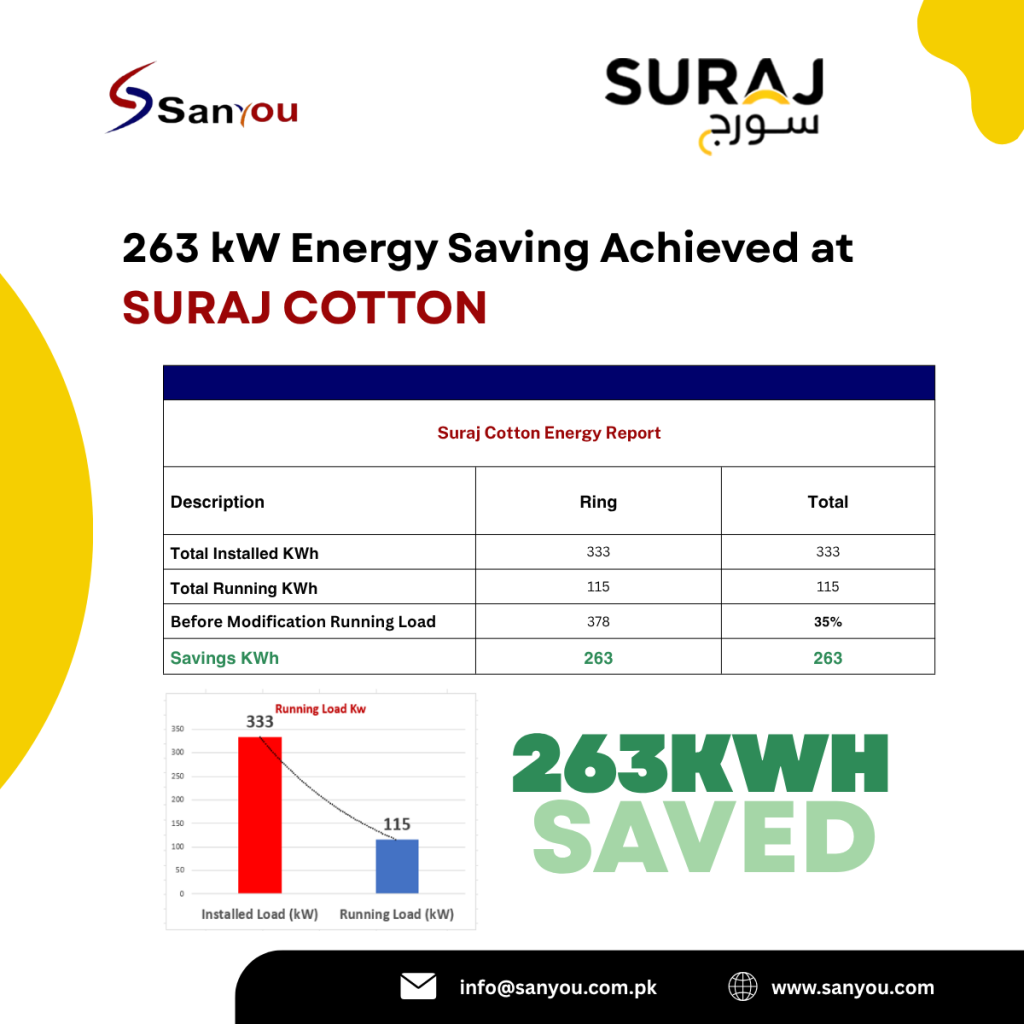
Case Study Ring Frame Section 263 kW Saved How Sanyou Machinery & Technology cut 263 kW from the Ring Frame section at Suraj Cotton — reducing running load from 378 kW to 115 kW with zero production downtime. 📅 June 2026 ✍ Sanyou Machinery & Technology ⏰ 7 min read Ring frame energy saving in Pakistan delivered a breakthrough result at Suraj Cotton, where Sanyou’s engineering audit of a single Ring section uncovered and eliminated 263 kW of avoidable electrical load — the equivalent of powering more than 260 average Pakistani homes, removed permanently from the mill’s monthly utility bill. 333 kW Installed Load 378 kW Load Before Modification 115 kW Running Load After 263 kW Total Saved Ring Frame Energy Saving in Pakistan: The Situation at Suraj Cotton Suraj Cotton operates a Ring Frame spinning section with an installed electrical capacity of 333 kW. Before Sanyou’s intervention, the actual running load measured at 378 kW — a figure that exceeded even the installed nameplate capacity. This is not uncommon in mills where reactive power losses, power factor degradation, and uncontrolled ancillary loads push the metered consumption above the theoretical installed rating. The mill had no section-level sub-metering. No variable frequency drives had been installed on fan or suction motors. Power factor had never been corrected at the Ring section panel. The electrical system was running exactly as it had been commissioned — with no optimisation applied at any point in the section’s operational life. Sanyou Machinery & Technology was brought in to conduct a targeted ring frame energy saving project. The scope was focused: one section, one audit, one engineered solution. The result was a 263 kW reduction — a 69.6% decrease in running load that continues to save the mill millions of rupees every month. Important: Running Load Exceeded Installed Load The before-modification running load of 378 kW exceeded the installed nameplate capacity of 333 kW. This happens when reactive power (kVAR) drawn by induction motors at poor power factor inflates the apparent load on the metering system. A mill being billed on kVA rather than kW will pay for every unit of this reactive excess. Power factor correction alone — before any VFD installation — can immediately bring metered consumption below the installed rating. What the Ring Frame Energy Audit Found at Suraj Cotton Sanyou’s engineers conducted an individual motor clamp meter survey across the entire Ring section during steady-state production. Four distinct sources of correctable waste were identified. 1 Severely degraded power factor The Ring section’s power factor had dropped below 0.72. At this level, every motor in the section was drawing substantial reactive current from the supply — current that does no productive work on fibre but appears on the WAPDA kVA meter and is billed accordingly. This reactive excess was pushing the apparent running load above the installed nameplate rating, creating the 378 kW reading. In any ring frame energy saving project, power factor correction is always the first and fastest payback intervention. 2 Fixed-speed suction and exhaust fan motors Every ring frame in the section had pneumatic waste collection fans running at fixed full speed, 24 hours a day, regardless of spindle speed, count being spun, or production state. These fans were sized for maximum throughput conditions but were consuming full power even during count changes, doffing, and partial-load production. A VFD reducing fan speed to 80% of maximum drops power consumption to approximately 51% due to the cube law — a saving that compounds across every fan motor in the section. 3 Oversized ring frame motors at chronic partial load Ring frame main drive motors are sized at commissioning for the worst-case scenario: finest count, maximum spindle speed, and full spindle complement. In daily production at Suraj Cotton, the section was running coarser counts at reduced speeds. Motors sized for peak demand were operating at 35–50% of their rated capacity — the most inefficient operating point for any induction motor, combining high copper losses with poor power factor. 4 No sub-metering — waste was invisible The Ring section had never been individually metered. The entire spinning floor shared one utility meter, meaning the Ring section’s consumption had never been separated from other departments. Without individual measurement, no corrective action had ever been possible. Installing section-level sub-meters was the foundational step that made every subsequent intervention traceable and verifiable. The Result: 263 kW Eliminated from the Ring Section Suraj Cotton — Ring Section Load Comparison Installed Load333 kW Running Load Before Modification378 kW Running Load After Optimisation115 kW Total kW Saved263 kW Load Reduction69.6% Est. kWh saved per day (20h)5,260 kWh Est. monthly saving (PKR 60/unit)~PKR 9.5M/month Running Load Breakdown After Optimisation Energy Saved (eliminated) 263 kW — 69.6% Remaining Running Load 115 kW — 30.4% Key Result A single section. A single audit. 263 kW permanently eliminated. The Ring section at Suraj Cotton now runs at 115 kW — less than one-third of its pre-optimisation load. No machines were replaced. No production shifts were cancelled. Yarn quality and throughput were maintained throughout. The Engineering Interventions That Delivered the 263 kW Saving Power Factor Correction Capacitor banks sized and installed at the Ring section distribution panel. Corrected power factor from below 0.72 to 0.95+. Immediately reduced apparent load on the WAPDA meter below the installed nameplate rating. VFD Installation on Fan Motors Variable Frequency Drives installed on all suction and exhaust fan motors across the Ring section. Fan speed matched to actual production state. At 80% speed, power consumption drops to 51% of full-speed draw. Section Sub-Metering Individual sub-meters installed at the Ring section panel, providing real-time consumption data for the first time in the mill’s operational history. Enables ongoing monitoring and immediate detection of future load increases. Motor Right-Sizing Motors found running below 35% of rated capacity were flagged for right-sizing. Replacing an oversized motor with a correctly-rated unit for the same task reduces both active and reactive losses, compounding the savings from VFD and capacitor interventions. What 263 kW Saved