
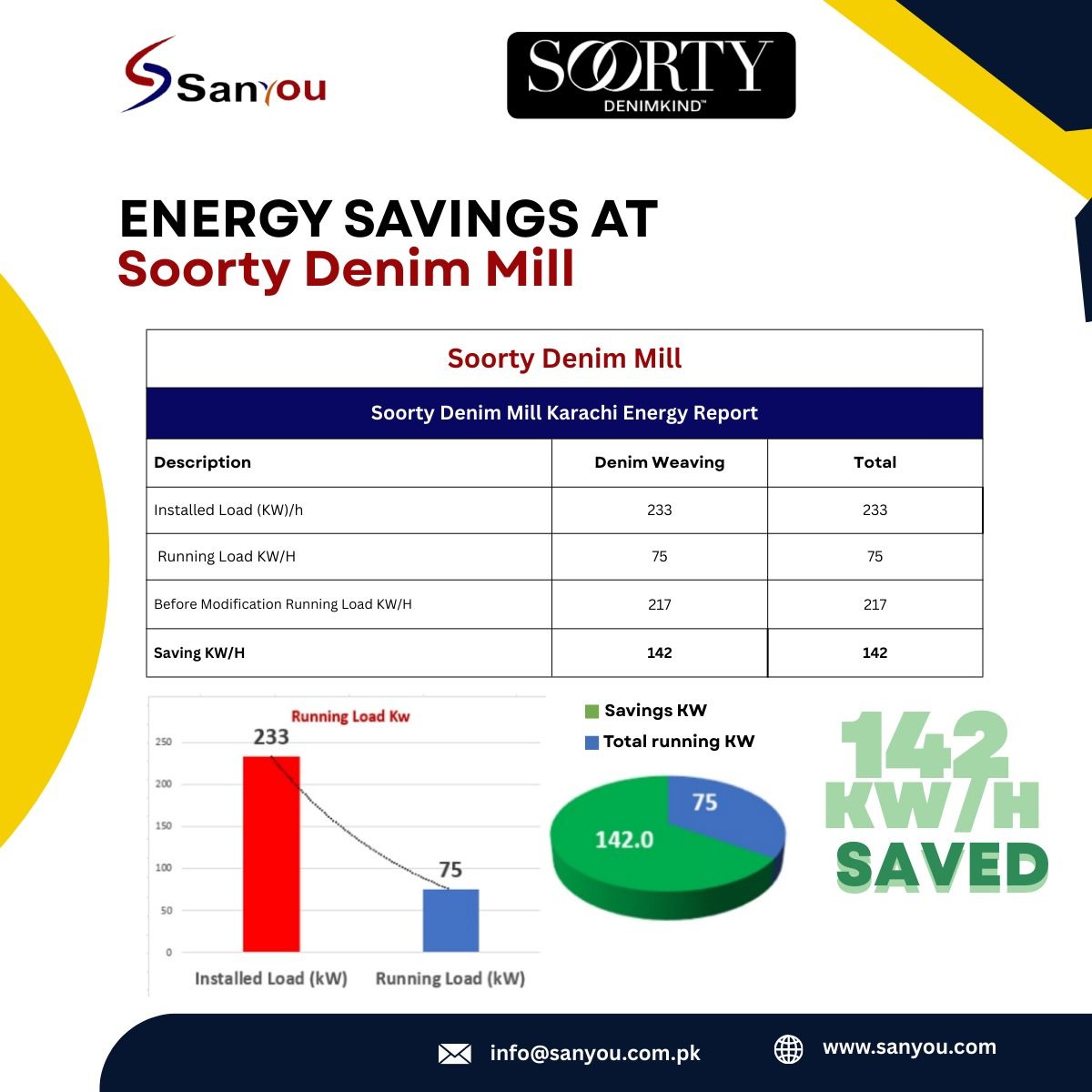
Energy consumption is one of the biggest operational costs in the textile industry, especially in processes like denim weaving where environmental control is critical. HVAC systems play a major role in maintaining temperature, humidity, and air quality—but they also consume a significant amount of power.
This case study highlights how Sanyou successfully implemented HVAC energy saving in textile industry at Soorty Denim Mill Karachi, achieving a remarkable reduction in AC running load while maintaining optimal production conditions.
Project Overview – Soorty Denim Mill Karachi
Soorty Denim Mill is one of the leading textile manufacturers specializing in denim production. The weaving department requires controlled environmental conditions to ensure consistent fabric quality.
Sanyou was assigned to optimize the HVAC system and reduce energy consumption without compromising airflow performance or production efficiency.
Initial System Performance (Before Modification)
Before optimization, the AC plant was operating at a significantly high load:
- Installed Load: 233 kW/h
- Running Load: 217 kW/h
This indicated that the system was operating near full capacity, resulting in:
- High electricity consumption
- Increased operational costs
- Inefficient airflow management
Such conditions are common in textile mills where HVAC systems are not optimized for actual process requirements.
Sanyou’s HVAC Optimization Approach
To achieve HVAC energy saving in textile industry, Sanyou implemented a strategic engineering approach focused on:
1. Airflow Optimization
Proper airflow distribution is critical in textile environments. Sanyou redesigned airflow patterns to ensure uniform air circulation across the weaving department.
2. AC System Modification
The existing AC plant was modified using advanced engineering techniques to reduce unnecessary load while maintaining required environmental conditions.
3. Load Balancing
System load was optimized to eliminate excess energy usage and ensure efficient operation across all components.
4. Performance Monitoring
Detailed analysis and performance tracking were conducted to ensure that energy savings were achieved without affecting production.
Performance After Modification
After implementing HVAC optimization, the results were highly impressive:
- Running Load Reduced To: 75 kW/h
- Energy Saved: 142 kW/h
This represents a massive improvement in system efficiency and power utilization.
Energy Saving Results
Key Achievements:
 142 kW/h energy saving
- Significant reduction in AC running load
- Improved system efficiency
- Stable environmental conditions for denim weaving
Before vs After Comparison:
| Parameter | Before | After |
|---|---|---|
| Running Load | 217 kW/h | 75 kW/h |
| Energy Consumption | High | Optimized |
| Efficiency | Low | High |
This case clearly demonstrates the impact of proper HVAC engineering in textile operations.
Why HVAC Energy Saving is Critical in Textile Industry
The textile industry heavily depends on controlled environments. However, poorly designed or outdated HVAC systems can lead to:
- Excessive energy consumption
- High production costs
- Inconsistent product quality
- Increased maintenance issues
By implementing HVAC energy saving in textile industry, mills can:
- Reduce electricity costs
- Improve operational efficiency
- Enhance product quality
- Achieve sustainable production
Sanyou’s Expertise in Textile HVAC Solutions
Sanyou specializes in delivering high-efficiency HVAC and energy-saving solutions tailored for textile industries.
Key strengths include:
- Advanced airflow engineering
- Customized AC system design
- Energy optimization strategies
- Proven track record in textile mills
Projects like Soorty Denim Mill demonstrate Sanyou’s ability to deliver measurable and impactful results.
Long-Term Benefits of This Project
The HVAC optimization at Soorty Denim Mill will provide long-term advantages:
1. Cost Reduction
Lower energy consumption directly reduces electricity bills.
2. Sustainability
Reduced power usage contributes to environmentally sustainable operations.
3. Improved Equipment Life
Optimized systems experience less stress, leading to longer equipment lifespan.
4. Better Production Environment
Stable airflow and temperature improve overall production efficiency.
Conclusion
This case study highlights how effective engineering and system optimization can deliver significant results in the textile sector. By achieving 142 kW/h energy saving, Sanyou has demonstrated a practical example of HVAC energy saving in textile industry.
For textile manufacturers looking to reduce operational costs and improve efficiency, investing in HVAC optimization is not just an option—it is a necessity.
If you are looking to reduce energy consumption in your textile mill, Sanyou offers expert solutions tailored to your needs.
Contact Sanyou today to optimize your HVAC system and achieve maximum efficiency.